The Fall season has kicked in with a vengance and the school where I teach has just started it's year with sign-ups for classes. As an instructor, I typically arrive about an hour before the sign-up actually starts to get organized, and to hear necessary announcements from the administration. I'm always impressed because when I arrive, there are already long lines of students waiting at the front and side doors to sign up for the classes - sometimes reaching down to the street and along the sidewalk from the front door and along the sidewalk all the way to the back of the parking lot and wrapping around on the side doors. Some of these folks have been waiting for hours and have brought folding chairs, books and beverages. As an organization, we're getting better at the this, and students seem to be getting better at the waiting game.
My DW was waiting in line to sign the kids up for some of the youth program classes at the school. A woman in front of her asked my DW and the other woman next to her if they'd hold her space while she went to get a cup of coffee at a nearby cafe. Both women said, sure - if she'd pick them up coffee, too and offered up the money for their cups. Community spirit, I say!
I'm always a bit apprehensive at sign-up because I never know if I'm going to fill the class that I'm teaching. If I don't meet these minimum enrollment standards, the class doesn't run, which would be disappointing. As many of you know, I've been teaching cedar-strip and fiberglass canoe construction for the past several years. There are some issues teaching this class in the facility where I teach in terms of space, the cost of materials to the students and the time required to finish a boat. This year, I was more apprehensive than usual as I'm teaching a new class and had no idea what the interest would be. The new class will be skin-on-frame boatbuilding and should be lower cost to students, easier to do in the facility and quicker build times. I was concerned that people wouldn't have the same "draw" to these boats that they do to the beauty of a bright finished wooden canoe, but they seem to recognize the unique features of the skin-on-boats including those listed above and light weight among others.
My fears seem to have been unfounded. I had a full class by the end of sign-up. A good sign.
One concern that people seem to have about the skin-on-frame boats is durability. I'll admit that when I was building my sea kayak, I had that at the back of my mind - that is, until I saw this video from John Petersen of Shaman Kayaks:
I found this to be completely true when I went to Maine with my kayak this summer. The Maine coast is unforgiving in that it is particularly rocky. The launching area where I was putting in had rocks, coarse gravel, broken shells of various types, barnacles, periwinkles and other hard, sharp objects. With the skin-on-frame boat, it's light - so you simply pick it up to put it where the least dangerous area is and even when I hit these things, there was only a small scratch - the skin flexes rather than rips over them.
So, to my new students - welcome aboard! It's going to be a memorable adventure!
Sunday, September 9, 2012

Wednesday, September 5, 2012

Monday, September 3, 2012
In the serious irony department...

This is what was in the "spam" comments trap for Paddling Upstream after the post on "Love Boats" last week:
order viagra online from canada viagra online boots - viagra dosage....
More than a little ironic, no?
Made me smile.
Friday, August 31, 2012
Thursday, August 30, 2012
Va-Va-Va-Voom!
This little piece of historical wonder from the Collector's Weekly website was posted at the WoodenBoat Forum today and was too good not to pass along. Both Benson Gray and Roger Young are active in the WCHA and provided some great information for this article.
Enjoy!

(Thanks to Benson Gray, Roger Young, Dave Smith, Shorpy, Newton Conservators)
Enjoy!
Love Boats: The Delightfully Sinful History of Canoes
By Hunter Oatman-Stanford
Before the youth of America fooled around at drive-ins and necked on
Lover’s Lane, they coupled in canoes. Boatloads of them. In the early
1900s, canoes offered randy young guys and gals a means of escape to a
semi-private setting, away from the prying eyes of their pious Victorian
chaperones.
“To go canoeing on the weekend was pretty much what you did with your
best girl,” says canoe enthusiast and collector Roger Young. “There
weren’t a whole lot of motorcars around at that time. You could go bicycling, but to go out canoeing was the thing.”
These canoes weren’t your typical summer camp variety; they were
designed for afternoons (and evenings) of stylish leisure. Most boaters
accessorized them with pillows, lanterns, and picnicking supplies. Some
even customized their canoes with built-in phonographs—floating boom-boxes for the paddle set.
“One Minneapolis Tribune headline read ‘Girl Canoeists’ Tight Skirts Menace Society’”
Adolescents took to the waters with the urgency of salmon fighting
their way upstream, spawning a veritable canoe craze, particularly in
places like Boston along the Charles River and at Belle Isle, near
Detroit. While any canoe would do, companies such as Old Town, Kennebec,
and White marketed “courting canoes” specifically designed for
waterborne lovebirds. “These boats usually had long 4-foot decks and an
8-foot elliptical or oval cockpit,” says Young. “The woman would sit in
the bottom of the canoe on cushions with her parasol to shade her from
the sun, while her gentleman in his boater hat would paddle and probably
croon to her. Or she might read poetry to him.” Make no mistake; these
were wild times.

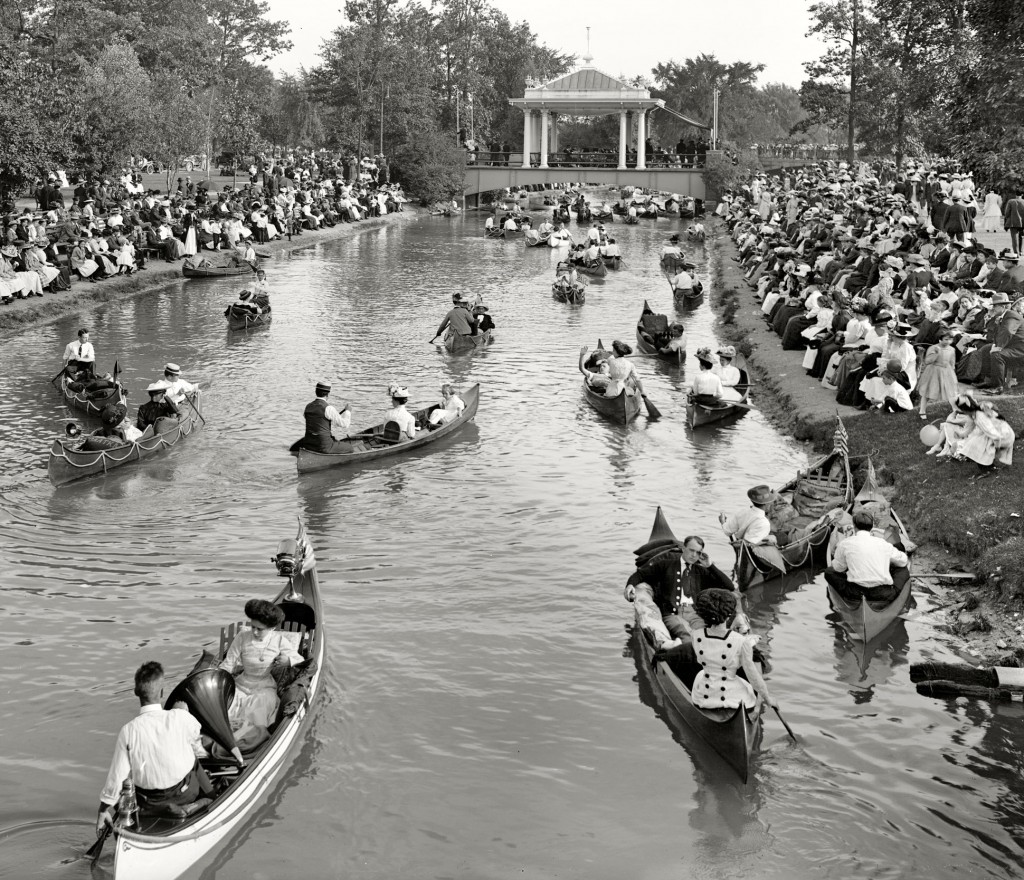
Canoeing
duos enjoy a concert on the Grand Canal at Belle Isle Park, in Detroit
circa 1907. In the lower left-hand corner, two boaters take advantage of
canoe luxuries like reclining seats and phonograph music.
Image
courtesy Shorpy.com.
In North America, the earliest canoes weren’t meant for leisure; they
were used by Native Americans as a means of efficient transportation
along busy trade routes. During the late 1700s, the birch-bark canoe was
adopted by European settlers to aid with the booming fur industry, and
by the mid-1800s, entrepreneurs in the Peterborough region of Canada
modified the standard canoe design to a more durable wood-plank
construction.
Canoeing as a sport can be traced to Scottish lawyer John MacGregor,
who designed a type of covered canoe using both a sail and paddles that
he called the “Rob Roy.” MacGregor’s love of travel motivated him to
commission this specialized boat from Searle & Son of London in
1865. The resulting canoe had cedar decks and an oak hull, and at 15
feet long was just short enough to fit into a train car.
To help publicize the freedoms of solo canoe travel, MacGregor chose
popular routes through central Europe, like the Danube River, where he
experimented with his new craft and discussed its merits with locals.
The following year, he published a book about his experiences, espousing
the many virtues of travel by canoe. But even MacGregor, who was also
the inventor of the pleasure boat, noted that his craft offered plenty
of space for horizontal bliss, “with at least as much room for turning
in your bed as sufficed for the great Duke of Wellington.”
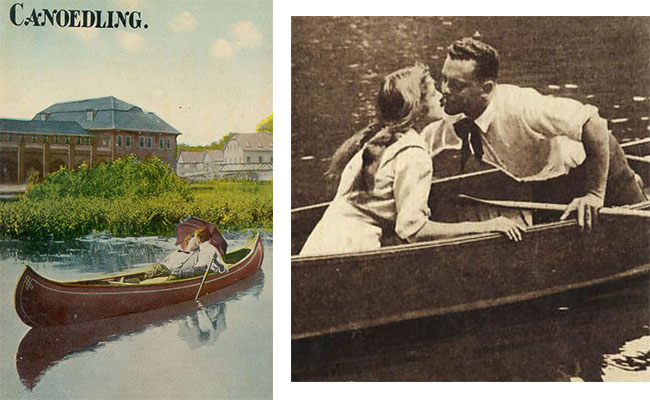
Two
postcards from the early 1900s capitalize on the popularity of
scandalous "canoedling," though the word most likely evolved from the
German term “knuddeln,” meaning “to cuddle.”
Left image courtesy Benson
Gray.
The concept of canoes as recreational vehicles was cemented. Regattas
and informal competitions spread throughout the 19th century, and a
centrally organized sporting group, the American Canoe Association, was
founded in 1880. Simultaneously, the industrialization and urbanization
of the factory world implemented new ideas about “weekends” and “free
time,” when people could enjoy personal interests and pursuits.
According to Benson Gray, the great-grandson of the Old Town Canoe
company’s founder, “urban populations were looking for something to do
on the weekends, and streetcar companies were more than happy to take
them out of the cities to local waterways where they could paddle around
in canoes.”
Increasing globalization also led to large international expositions,
like the Chicago World’s Columbian Exhibition of 1893, where various
styles of indigenous and modern canoes were presented to the public
alongside other technological marvels. Canoe clubs and rental facilities
soon popped up in parks across the country, from San Francisco to New
Orleans to New York City.
“In its heyday,” says Young, “thousands of young and even older folks
would turn out in these popular areas, so many that it was often said
you could cross the river without getting wet simply by stepping from
canoe to canoe. There were even policemen patrolling by canoe as
‘morality enforcement,’ making sure that everyone remained upright and
reputations remained intact.”
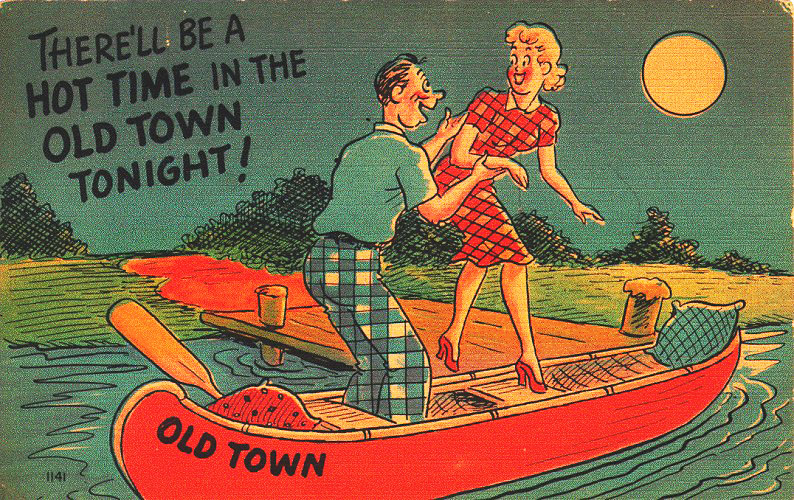
A comic postcard advertising Old Town Canoes makes an open joke of their preferred use.
Image courtesy Benson Gray.
In 1903, before the trend really took off, a “Boston Herald” article
scoffed at the effectiveness of puritanical boating ordinances: “It may
not be wicked to go canoeing on the Charles with young women on Sunday,
but we continue to be reminded that it is frequently perilous…The
canoeist arrested for kissing his sweetheart at Riverside was fined $20.
At that rate it is estimated that over a million dollars’ worth of
kisses are exchanged at that popular canoeing resort every fine Saturday
night and Sunday.”
A 1904 souvenir brochure for the Charles River area emphasized its
natural beauty and praised the healthful benefits of boat trips,
interspersing scenic photographs with lines of poetry. The pamphlet
began, “If you are fortunate enough to be canoeing at sunset…and to
spend an evening on the river during a concert or an illumination, to
see the canoes appearing one by one, tastily decorated with Japanese
lanterns, to hear the sweet tones of a passing guitar or the strains of
some glee club floating down stream, you can very easily imagine
yourself in Fairyland.” If the make-out potential of a canoe date wasn’t
clear enough, accompanying advertisements for no less than 10 different
chocolate companies drove the point home.
By 1912, in Minnesota, the undisputed lake capitol of the U.S., canoe
permits and rental spaces were off the charts. The Minneapolis Parks
Department’s 2,000 permit spaces were almost maxed out, and the city was
having a tough time enforcing its 12 a.m. lake curfew. A “Minneapolis
Tribune” story reported that, “misconduct in canoes has become so grave
and flagrant that it threatens to throw a shadow upon the lakes as
recreation resorts and to bring shame upon the city.” Regardless of the
curfew, a lot could happen in the dark hours between dusk and midnight,
inspiring park police to patrol the lakes for inappropriate behavior on
motorized boats equipped with spotlights.
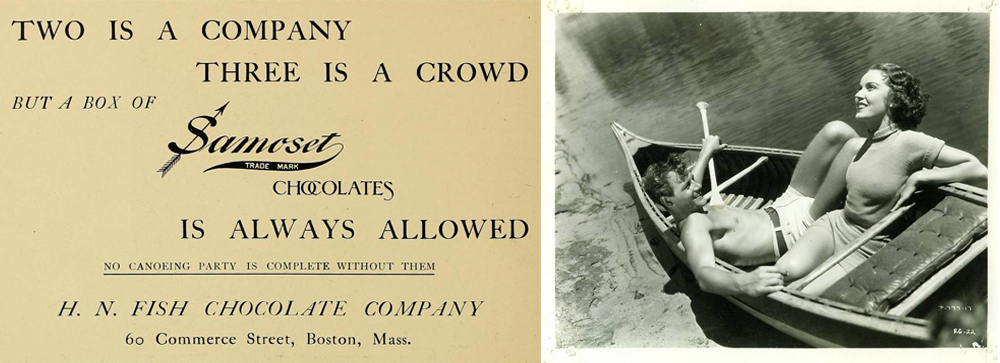
Left:
A canoe-centric advertisement for Samoset Chocolates worded to entice
romantic twosomes.
Right: Hollywood finally recognizes the potential of
sinful canoeing, over a decade too late, in a publicity still from the
1930s featuring Joel McCrea and Maureen O'Sullivan.
As further proof that canoeing had become a hotbed for teenage
delinquents, in 1913 the Minneapolis Parks Board refused to issue
permits for canoes with unpalatable names. Local newspapers published
some of the offensive phrases that slipped past the board the previous
summer, including “Thehelusa,” “Kumomin Kid,” “Kismekwik,” “Damfino,”
“Ilgetu,” “Aw-kom-in,” “G-I-Lov-U,” “Skwizmtyt,” “Ildaryoo,”
“Win-kat-us,” “O-U-Q-T,” “What the?,” “Joy-tub,” “Cupid’s Nest,” and “I
Would Like to Try It.” The commissioners unanimously agreed to outlaw
phrases lacking obvious moral and grammatical standards, though a few of
these clever pre-text-message abbreviations clearly had them scratching
their heads.
Meanwhile, the drama was heightened by a frenzied headline printed by
the “Tribune” in June of 1914: “Girl Canoeists’ Tight Skirts Menace
Society,” it wailed. In the article itself, F.C. Berry, a supposed park
expert on recreational features, warned of the dangers narrow skirts
posed to female boaters—in the event of a capsize, they’d be unable to
swim.
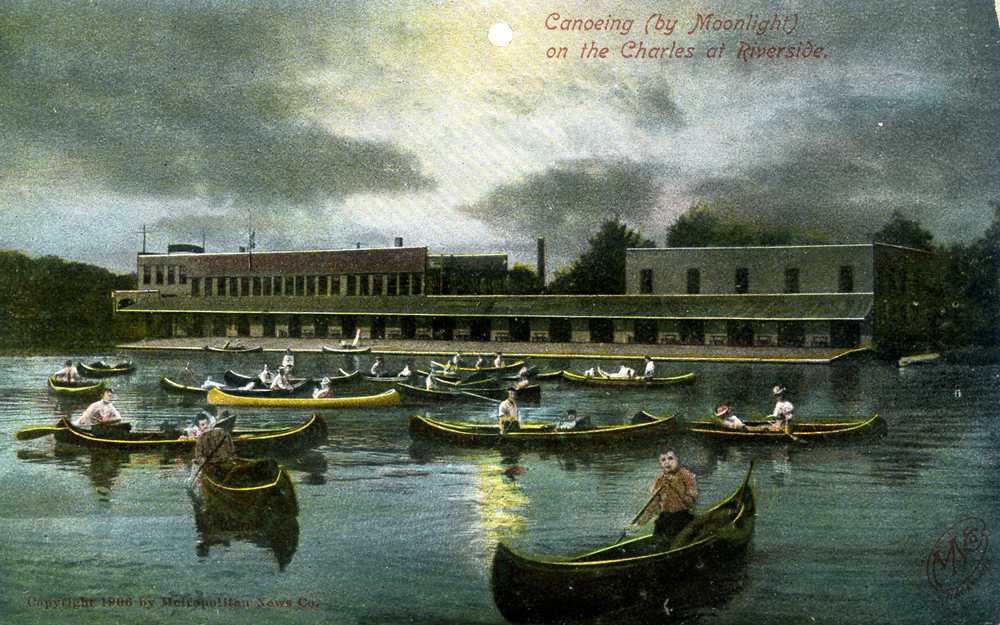
A
postcard from 1906 advertises the supposedly chaste pleasures of
night-time boating on the Charles River near Boston.
Image courtesy
Newton Conservators.
Whether or not any actual drownings were attributed to tight skirts,
safety wasn’t the top concern for most canoers; a boat’s ability to hold
two passengers, preferably side by side, was generally of higher
priority. Though the Minneapolis Parks Board attempted to institute an
ordinance requiring opposite sex couples (over age 10) to sit facing
each other, public outcry helped to quickly repeal the restriction.
By 1916, the canoe-courting trend was widespread enough to warrant
mention in a musical comedy called “Tres Rouge” by Jay Gorney, which
included a song called “Out in My Old Town Canoe.” But this floating,
petting paradise would not last. “When motorcars became more available
in the early ’20s, courting in canoes sort of fell off,” says Young.
“Guys were getting into their Model Ts or Model As and going off with
girls for a Sunday drive instead of canoeing.” And what went on in the
backseats of those cars? Well, that’s a whole different story.
(Thanks to Benson Gray, Roger Young, Dave Smith, Shorpy, Newton Conservators)
Wednesday, August 22, 2012

Wednesday, August 15, 2012

Subscribe to:
Posts (Atom)


 Posts
Posts


