Showing posts with label Canoe. Show all posts

Monday, November 18, 2013

Old School.

Ok, my French isn't so good, but this video is an opportunity to watch masters at work, doing what may soon be considered a "lost art".  With any luck, video documentation like this will save this information for the future. 

Watch.

Learn.

Enjoy.


Wednesday, June 26, 2013

Happy National Canoe Day!


The Canadians have it right - on June 26th every year (or thereabouts...) - they celebrate National Canoe Day.  This event was founded by the Canadian Canoe Museum to celebrate the canoe which was voted by Canadians to be one of the Seven Wonders of Canada.

Being good neighbors, we here in the US should celebrate with them!

Sunday, June 9, 2013

Exhibition 2013

The school where I teach had their annual exhibition and my students and I had the opportunity to display our boats that we've been making over the past year.  Sadly, we had weather that reminded me of last year's event on Friday night.  It came down in buckets - we had at least 4" of rain.  Fortunately they have us display our boats on the front lawn under a large tent.  Still, I will save your delicate ears by not giving you my comments on the weather, but suffice it to say that I was a drowned rat when I returned home Friday after the show.

Saturday dawned a much nicer, sunnier day and our collective disposition was much better.  So, without further ado, here are some of the pictures:

Placed out front is the Genny - a 15' Solo Portage design from Rob Macks at Laughing Loon that was built by a former student with my help - it was kind of his master's level project in boatbuilding.  The hull is 3/16" thick Northern White Cedar.  Feature strip and trim are Walnut - both American and Peruvian.


 Decks are crotched Walnut burl.


It's a stunning canoe and well made, to boot.

Hiding behind that is the modified Sea Tour 15 that I finished last year as an example of what is possible.  I've been enjoying it and the speed and durability of the skin boat.  It always seems to draw interest.  It still doesn't have a name.  I've been thinking of the Banana Boat and painting a huge blue Chiquita sticker on the deck.


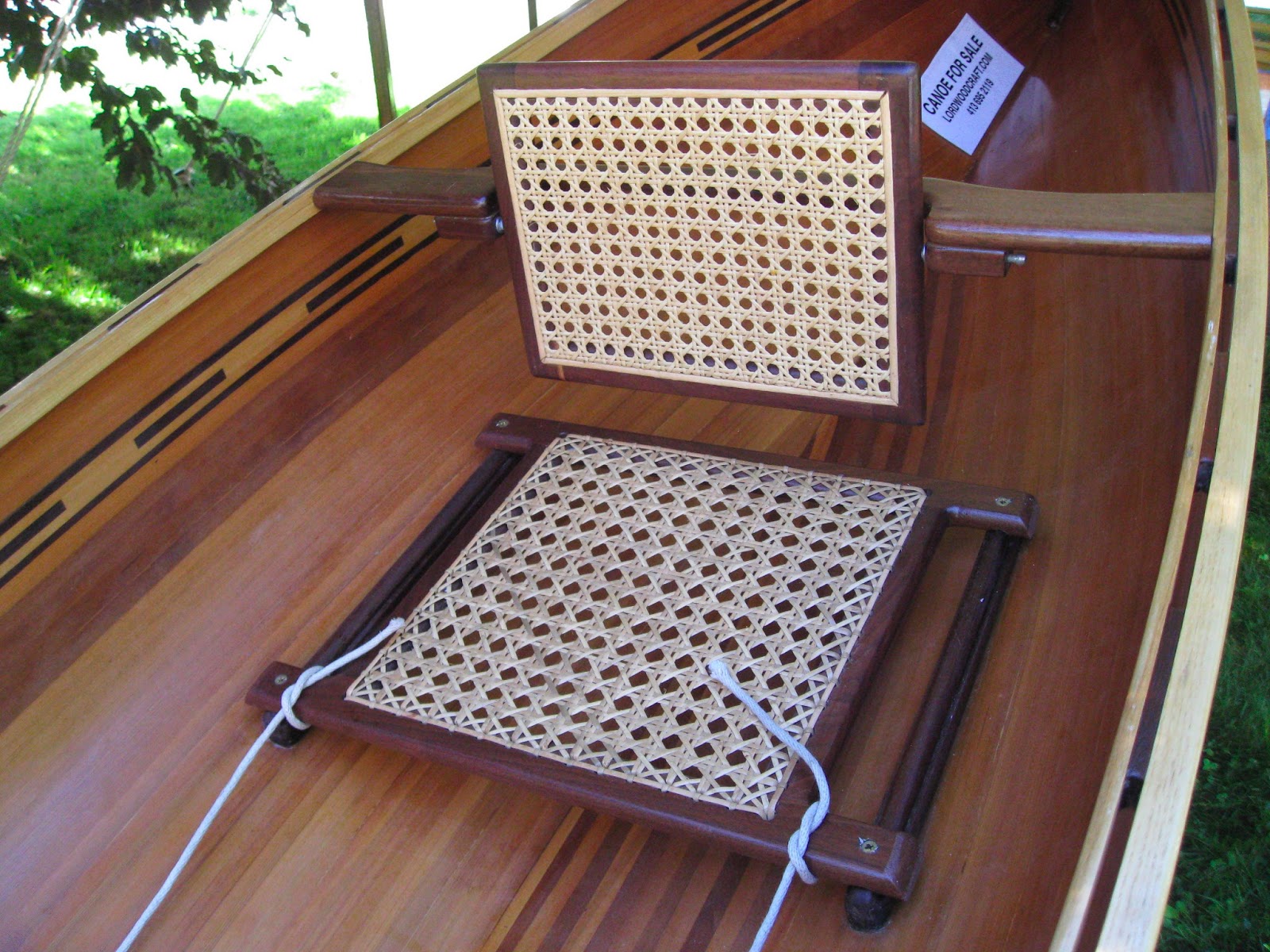
Hidden behind is the other stripper that was made by the student who built the Genny.  This canoe, the Harpoon, was built in the class and is a Wee Lassie II designed by Mac McCarthy of Feather Canoes.   Trim is Ash, Walnut, and Butternut and the hull is 1/4" thick Western Red Cedar.  The ropes that you see are for a foot bar and allow for quick adjustment for different paddlers.  Should you be looking for a canoe, it is for sale.


This is a detail of the seating area - a clever solution to remove the seat-back.  There are barrel catches that are both the seat pivots and let the back be removable for transport.


At the beginning of the year, we offered three different designs to the students.  They were the Stonefly canoe by S. Jeff Horton of Kudzucraft, and the Chuckanut 12 and Chuckanut 15 from Dave Gentry of Gentry Custom Boats.  I figured we'd have a "little of this" and a "little of that" in the class, but we ended up with 7 of the Stonefly canoes and one of the Chuckanut 15's.

Here is one of the more interesting paint jobs that I've seen put on the canoes so far.  The owner is a talented woodworker in his own right, and has done an outstanding job on the woodwork.  I guess I shouldn't have been surprised about the creativity of the paintwork.


He was just applying the trim at exhibition.  Today was another beautiful day, I hope he got a chance to paddle it.

This one is by a woman who started the class with somewhat more limited skills, but still has created a very beautiful boat.  While we bond and screw or peg the stringers to the frames, she chose to add a more traditional touch by adding cosmetic lashings to all the joints as well as lashing the floorboards.  (All of the students lash the floors to the frame...)


Scupper blocks, decks and rub rails will be from Walnut and the contrast with the Western Red Cedar frame are stunning.  We hope to skin this boat this week.

This boat is being built by a fellow who has been developing his woodworking skills at the school and has done a splendid job of building his canoe.  I'm really looking forward to seeing the decks in the sunlight - they're figured English Chestnut.


This boat was built by a student who was enthusiastic to build a light-weight canoe to use in the Adirondacks.  He's made some unique choices during the build regarding his scupper blocks and has done a nice job with it.  The brilliant red should be very visible on the water!


This is a unique canoe for us - it was done with White Pine stringers (like the yellow kayak) and is very pretty with the blonde wood.


Decks are Bird's Eye Maple and this boat has a sculpted backrest.


This is the lone Chuckanut 15.  The gentleman who was building the kayak is 82 years young and is building the kayak to share with his grandchildren.  The colors were selected to represent the college colors of some of the grandchildren.


Oh, yeah - he also built two paddles - one of which is in the picture.


Two canoes were MIA.  One belongs to a student who gets around by bicycle - and plans to haul the canoe on a trailer behind the canoe, but had difficulty getting it back for exhibition because of this fact.  The other belongs to a builder who had some serious changes in his life that occurred during the class and has moved to New York.  He had come up to stay with myself and my family and work on his canoe.   He'd applied finish to the frame and it wasn't dry enough to exhibit - a typical issue at boat shows - you can almost smell the varnish factory.   Still, by the end of this weekend, the frame was varnished, decks and thwarts installed and the floors ready to lash in place.  From there, just skin and trim.  I hope to have pictures from the group launch party of these two boats. 

During the course of the class, we discovered that the Stonefly design had a small issue because of some of the way we chose to finish the gunwales and decks.  There was a slight "hourglass" shape that appeared in the aft end of the canoe.  So, I decided that I'd like to change the design of the aft frame to get rid of this curvature.  However before I turn this loose on the students, I figured I'd better build one.  Here it is:


I went with Mahogany for floorboards and trim.  I like the traditional shapes from wood and canvas canoes and took some cues from the class I took with Jerry Stelmok in tapering the gunwales and the shapes for the decks - curved with a hollow back - and the brass stem band and painter loop on bow and stern.


I have to admit that I had a bit of fun with the back rest.  It is a curved pivoting back-rest with some stars carved into the top of the cross-member.  I painted them gold before varnishing.  I thought it came out rather nicely.


One of my concerns when I started this class was that the boats wouldn't have the same aesthetic appeal that the cedar strip canoes did.  I had a set of clipboard out that visitors could leave contact information and be reminded of the sign-up for our next session in the fall - I have two full pages of folks who were interested in building a boat.  I guess I didn't need to worry!


Wednesday, May 8, 2013

Wednesday, May 1, 2013

Monday, March 4, 2013

Full House...

This is what I like to see...  Lots of work going on.

Makes you smile a bit, no?


Tuesday, February 5, 2013

Tech Tip Tuesday


Class has been ticking along with the students getting their frames near completion.  The canoe plans came from S. Jeff Horton's book on skin-on-frame building that's available on Amazon - he's even got a second book available.  

Before you take issue with what I write here and think that I'm throwing Jeff "under the bus" as it were, I'm not.  I think he does some interesting things and offers some good designs, but I think he lacks some experience with other canoe building traditions.  Even he states that he's not really a "canoe guy" and I think that hampers him in designing a skin-on-frame canoe.  I do think that for our application, we've made some improvements to the design in terms of functionality and aesthetics.

He's got what looks to be a great shape for the canoe, but I take issue with a few of his construction details.  First, in his design, he notches the bottom of the frames where a plank boat would have garboards to put in floors.  First, the notching weakens the frames significantly.  While Jeff shows a slightly raised seat in his design, we really want the paddler to sit as low as possible in the canoe. This would have the paddler's butt in any water that might be on the floor if they were sitting that low.  Last but not least, the fabric rides right on the floors, which doesn't allow the fabric to flex over obstacles that you might encounter in the water, resulting in potential damage to the skin. 

To avoid these issues, we didn't notch the frames and will lash a floor to the top of the frames which I think will be a practical and more attractive solution.  It should look very much like "duckboards" used to in a traditional canoe.

The other thing that I've been thinking about for quite some time is how to make the gunwales more traditional in their appearance.  When building a wood and canvas canoe, the ends of the inwale and outwale often have a graceful taper to them and the stem is mortised to allow the gunwale to pass by and give a nice triangular area for the deck to sit within. 

On Jeff's canoe, he has the deck as a "cap deck" which lets him hide the fact that the inwales aren't well fitted.  He claims that this type of woodwork is beyond most, but I think that's a little simplistic.  To be honest, I've been thinking about this for a while and last weekend, we made a test cut on the first boat.

We started by placing the inwale in place and clamping it to the end of the stem.  We made a horizontal mark at the bottom of the inwale.  We also marked the centerline of the stem face.  Using a bevel gage, we took the angle that the inwale met the stem and marked from the centerline to outside faces.  A vertical line completes the marking.


 Using a handsaw, we roughed away the material and finished with a chisel.  Here is the result:


The next step was to take the inwale and taper it from a 1/8" thickness at the end of the stem to full thickness at the first form.  We repeated this for the outwale and made a tapered spacer that went between the inwale and outwale.  The length of the spacer was such that the thickness of the outwale was 7/16" where the spacer ended.  There is an important reason for this - we'll be using 3/8" long staples to attach the fabric to the outwales and don't want the staples poking though into the scupper openings.
 

I think that the tapered ends look very nice.  We still have a bit to go on this idea yet - Jeff's scupper blocks were irregularly spaced, so we're going to deal with that.  To do that we'll cut down the frames by about half an inch or so in order to hide them with pieces of the Western Red Cedar used for the gunwales allowing us to make more uniformly spaced scuppers.  Also, the stem ends will be cut down and the breasthooks tips will be notched underneath to allow only the deck to be seen, not the end of the stem frame.

More to come!

Wednesday, January 9, 2013

Saturday, November 3, 2012

Slow, but steady progress.

Preparation is half of boat building.   The students in my class have been working diligently preparing materials to assemble into skin-on-frame boats.  We started with a half sheet of marine grade plywood and some western red cedar and pine lumber. Using a set of master patterns  (the light colored parts on the table), they traced the outlines of the shapes onto the ply.


Then,  they rough cut the outlines using jigsaws and bandsaws and cut the notches for the stringers.  


Once the outlines were rough cut, we used carpet tape to bond the master patterns to the rough cut frame.  We then used a pattern bit in the router table to make the pieces that the students were making exactly the same as the patterns.


After the frames have been cut, a finish fit is made for the stringers with a fine rasp.


Once the notches have been fitted, a test piece should fit smoothly into the notches.


The stringers were cut on the table saw.  We used full length pieces, but shorter pieces could have been scarfed together to make stringers of the appropriate length.  Once the stringers were cut, we used a router to round over the corners where appropriate.  This is for two reasons - to put a better finish on the stringers (finish thins out on sharp corners) and to put a rounded edge to protect the fabric that will be stretched over the frame.


Finally, we've assembled the strongbacks to build the boats on.  (Note the sawhorses from the previous posts.)  We've built a few new strongbacks, will try to re-use some old ones and 2x4's that are recommended for this build method.


Frames go together quickly once the material is prepped.  I expect to be able to show some mostly finished frames after next week's class.

Wednesday, September 12, 2012

Thursday, August 30, 2012

Va-Va-Va-Voom!

This little piece of historical wonder from the Collector's Weekly website was posted at the WoodenBoat Forum today and was too good not to pass along.  Both Benson Gray and Roger Young are active in the WCHA and provided some great information for this article.

Enjoy!

Love Boats: The Delightfully Sinful History of Canoes

By Hunter Oatman-Stanford


Before the youth of America fooled around at drive-ins and necked on Lover’s Lane, they coupled in canoes. Boatloads of them. In the early 1900s, canoes offered randy young guys and gals a means of escape to a semi-private setting, away from the prying eyes of their pious Victorian chaperones.

“To go canoeing on the weekend was pretty much what you did with your best girl,” says canoe enthusiast and collector Roger Young. “There weren’t a whole lot of motorcars around at that time. You could go bicycling, but to go out canoeing was the thing.” These canoes weren’t your typical summer camp variety; they were designed for afternoons (and evenings) of stylish leisure. Most boaters accessorized them with pillows, lanterns, and picnicking supplies. Some even customized their canoes with built-in phonographs—floating boom-boxes for the paddle set.
“One Minneapolis Tribune headline read ‘Girl Canoeists’ Tight Skirts Menace Society’”
Adolescents took to the waters with the urgency of salmon fighting their way upstream, spawning a veritable canoe craze, particularly in places like Boston along the Charles River and at Belle Isle, near Detroit. While any canoe would do, companies such as Old Town, Kennebec, and White marketed “courting canoes” specifically designed for waterborne lovebirds. “These boats usually had long 4-foot decks and an 8-foot elliptical or oval cockpit,” says Young. “The woman would sit in the bottom of the canoe on cushions with her parasol to shade her from the sun, while her gentleman in his boater hat would paddle and probably croon to her. Or she might read poetry to him.” Make no mistake; these were wild times.


Canoeing duos enjoy a concert on the Grand Canal at Belle Isle Park, in Detroit circa 1907. In the lower left-hand corner, two boaters take advantage of canoe luxuries like reclining seats and phonograph music. 
Image courtesy Shorpy.com.

In North America, the earliest canoes weren’t meant for leisure; they were used by Native Americans as a means of efficient transportation along busy trade routes. During the late 1700s, the birch-bark canoe was adopted by European settlers to aid with the booming fur industry, and by the mid-1800s, entrepreneurs in the Peterborough region of Canada modified the standard canoe design to a more durable wood-plank construction.

Canoeing as a sport can be traced to Scottish lawyer John MacGregor, who designed a type of covered canoe using both a sail and paddles that he called the “Rob Roy.” MacGregor’s love of travel motivated him to commission this specialized boat from Searle & Son of London in 1865. The resulting canoe had cedar decks and an oak hull, and at 15 feet long was just short enough to fit into a train car.

To help publicize the freedoms of solo canoe travel, MacGregor chose popular routes through central Europe, like the Danube River, where he experimented with his new craft and discussed its merits with locals. The following year, he published a book about his experiences, espousing the many virtues of travel by canoe. But even MacGregor, who was also the inventor of the pleasure boat, noted that his craft offered plenty of space for horizontal bliss, “with at least as much room for turning in your bed as sufficed for the great Duke of Wellington.”

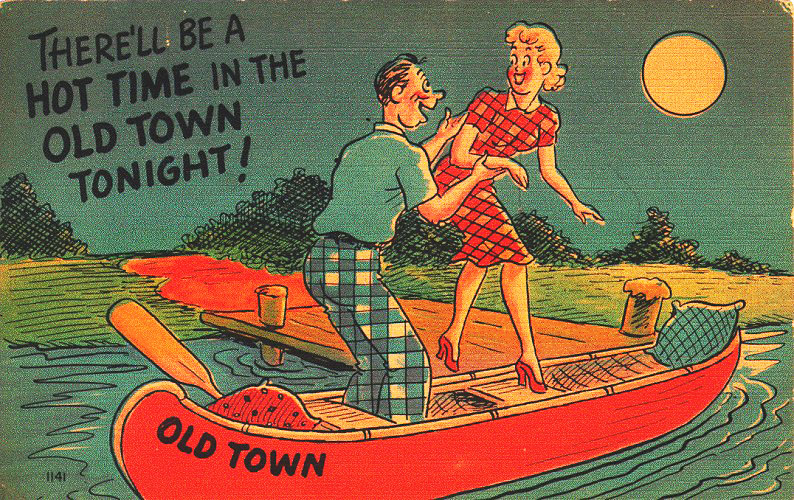
Two postcards from the early 1900s capitalize on the popularity of scandalous "canoedling," though the word most likely evolved from the German term “knuddeln,” meaning “to cuddle.” Left image courtesy Benson Gray.

Two postcards from the early 1900s capitalize on the popularity of scandalous "canoedling," though the word most likely evolved from the German term “knuddeln,” meaning “to cuddle.” 
 Left image courtesy Benson Gray.

The concept of canoes as recreational vehicles was cemented. Regattas and informal competitions spread throughout the 19th century, and a centrally organized sporting group, the American Canoe Association, was founded in 1880. Simultaneously, the industrialization and urbanization of the factory world implemented new ideas about “weekends” and “free time,” when people could enjoy personal interests and pursuits. According to Benson Gray, the great-grandson of the Old Town Canoe company’s founder, “urban populations were looking for something to do on the weekends, and streetcar companies were more than happy to take them out of the cities to local waterways where they could paddle around in canoes.”

Increasing globalization also led to large international expositions, like the Chicago World’s Columbian Exhibition of 1893, where various styles of indigenous and modern canoes were presented to the public alongside other technological marvels. Canoe clubs and rental facilities soon popped up in parks across the country, from San Francisco to New Orleans to New York City.
“In its heyday,” says Young, “thousands of young and even older folks would turn out in these popular areas, so many that it was often said you could cross the river without getting wet simply by stepping from canoe to canoe. There were even policemen patrolling by canoe as ‘morality enforcement,’ making sure that everyone remained upright and reputations remained intact.”


A comic postcard advertising Old Town Canoes makes an open joke of their preferred use. 
Image courtesy Benson Gray.

In 1903, before the trend really took off, a “Boston Herald” article scoffed at the effectiveness of puritanical boating ordinances: “It may not be wicked to go canoeing on the Charles with young women on Sunday, but we continue to be reminded that it is frequently perilous…The canoeist arrested for kissing his sweetheart at Riverside was fined $20. At that rate it is estimated that over a million dollars’ worth of kisses are exchanged at that popular canoeing resort every fine Saturday night and Sunday.”

A 1904 souvenir brochure for the Charles River area emphasized its natural beauty and praised the healthful benefits of boat trips, interspersing scenic photographs with lines of poetry. The pamphlet began, “If you are fortunate enough to be canoeing at sunset…and to spend an evening on the river during a concert or an illumination, to see the canoes appearing one by one, tastily decorated with Japanese lanterns, to hear the sweet tones of a passing guitar or the strains of some glee club floating down stream, you can very easily imagine yourself in Fairyland.” If the make-out potential of a canoe date wasn’t clear enough, accompanying advertisements for no less than 10 different chocolate companies drove the point home.

By 1912, in Minnesota, the undisputed lake capitol of the U.S., canoe permits and rental spaces were off the charts. The Minneapolis Parks Department’s 2,000 permit spaces were almost maxed out, and the city was having a tough time enforcing its 12 a.m. lake curfew. A “Minneapolis Tribune” story reported that, “misconduct in canoes has become so grave and flagrant that it threatens to throw a shadow upon the lakes as recreation resorts and to bring shame upon the city.” Regardless of the curfew, a lot could happen in the dark hours between dusk and midnight, inspiring park police to patrol the lakes for inappropriate behavior on motorized boats equipped with spotlights.


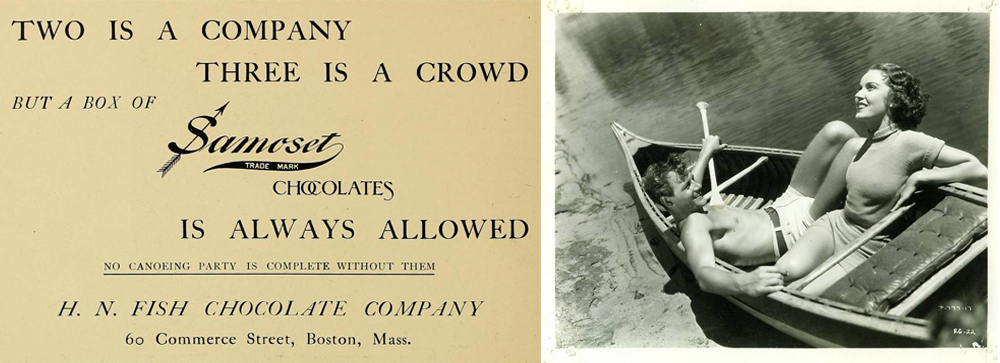
Left: A canoe-centric advertisement for Samoset Chocolates worded to entice romantic twosomes. 

Right: Hollywood finally recognizes the potential of sinful canoeing, over a decade too late, in a publicity still from the 1930s featuring Joel McCrea and Maureen O'Sullivan.

As further proof that canoeing had become a hotbed for teenage delinquents, in 1913 the Minneapolis Parks Board refused to issue permits for canoes with unpalatable names. Local newspapers published some of the offensive phrases that slipped past the board the previous summer, including “Thehelusa,” “Kumomin Kid,” “Kismekwik,” “Damfino,” “Ilgetu,” “Aw-kom-in,” “G-I-Lov-U,” “Skwizmtyt,” “Ildaryoo,” “Win-kat-us,” “O-U-Q-T,” “What the?,” “Joy-tub,” “Cupid’s Nest,” and “I Would Like to Try It.” The commissioners unanimously agreed to outlaw phrases lacking obvious moral and grammatical standards, though a few of these clever pre-text-message abbreviations clearly had them scratching their heads.

Meanwhile, the drama was heightened by a frenzied headline printed by the “Tribune” in June of 1914: “Girl Canoeists’ Tight Skirts Menace Society,” it wailed. In the article itself, F.C. Berry, a supposed park expert on recreational features, warned of the dangers narrow skirts posed to female boaters—in the event of a capsize, they’d be unable to swim.


A postcard from 1906 advertises the supposedly chaste pleasures of night-time boating on the Charles River near Boston.  
Image courtesy Newton Conservators.

Whether or not any actual drownings were attributed to tight skirts, safety wasn’t the top concern for most canoers; a boat’s ability to hold two passengers, preferably side by side, was generally of higher priority. Though the Minneapolis Parks Board attempted to institute an ordinance requiring opposite sex couples (over age 10) to sit facing each other, public outcry helped to quickly repeal the restriction.

By 1916, the canoe-courting trend was widespread enough to warrant mention in a musical comedy called “Tres Rouge” by Jay Gorney, which included a song called “Out in My Old Town Canoe.” But this floating, petting paradise would not last. “When motorcars became more available in the early ’20s, courting in canoes sort of fell off,” says Young. “Guys were getting into their Model Ts or Model As and going off with girls for a Sunday drive instead of canoeing.” And what went on in the backseats of those cars? Well, that’s a whole different story.

(Thanks to Benson Gray, Roger YoungDave SmithShorpyNewton Conservators)


Thursday, July 19, 2012

Pemigewasset River Trip


We took a trip back in June with some friends on the Pemigewasset River in New Hampshire.  The Pemi, as it is known up there, is a fairly gentle river that is known for it's sandy bottom and clear water.  Trusting in the scouting reports of friends that we were paddling with, we brought two wooden canoes - the lapstrake Charlotte and a cedar strip Wabnaki and DW's new Tupperyak.  We drove there on a Friday and stayed at a private campground right on the water in Thornton, NH.

The campsites were small, but clean and there were great amenities and services for campers.  The sites that our group had were literally right on the water.  Our plan was to get a shuttle upstream that was provided by the campground and paddle back downstream to the campground on Saturday, returning home on Sunday.  That's one of the wonderful things about the Northeast US.  There are many accessible mini-wilderness experiences that you can enjoy on a weekend.  At any rate we spent Friday evening setting up camp, having dinner and enjoying a campfire with old friends and some new ones as well.  Here's a view of the campsite:


Just beyond the canopy and the trees was the river.  This was the view from the campsite - an old railroad bridge:


I noted that the Pemi was a sandy bottomed river. Well, it was, until Irene came through last year.  Most of the river bottom was a bit "bony" in that most of the sand had been washed up onto the banks of the river and new channels carved out by the rushing flood-waters from Hurricane Irene.   While I understood that there was a rockier section of the river up near Woodstock, I'm not sure that I was fully ready for what I found.  When we finally put in on Saturday we'd gone a few hundred yards downstream and had to get out and walk the boats.  The river was shallow and fast with barely enough water to float the boats in some spots.  Some bits included some pretty fast Class I and Class II water with obstacles to paddle around.


I was particularly impressed with DW and DD's abilities to read the river and find safe routes through the whitewater stretches of the river.  What was even more impressive was the amount of water toys on the river.  Our group had brought squirt guns of various forms and some Stream Machine water blasters.  We ran into a group of Boy Scouts who were of a similar mind and were "well armed".  When the first overtook us, they pulled out squirt guns and began to ply streams of water in our direction.  They definitely regretted that shortly after.  Two of our group had the Stream Machines out and soaked the Scouts with 1/4" streams of water.  This went on for most of the day.

Timing seemed to be with us as we approached the end of our journey.  A stiff breeze blew up that portended some heavier weather.  Thunder and a bit of lightning appeared upstream from us and we managed to get off the river just as some sprinkles of rain began to fall.  Fortunately for us, the storm went around us and we stayed dry.

Dinner was a pot-luck affair with a campfire to follow.  Another great evening.

The trip was not without casualties, however - the Wabnaki has some new battle scars:


Be prepared for me to use this boat as an object lesson for some Tech Tip Tuesday learning to follow.  People often talk about how fragile that cedar strip and fiberglass canoes are, but I'll be showing you the wonder of how you can restore the canoe to like-new glory!

Wednesday, November 16, 2011

Friday, November 11, 2011

Progress from the Thotful Spot


One of the things that I was thinking about was how to finish the decks and inwales where they meet the stem ends at bow and stern.   There are, frankly, many ways to solve this.  However, I'm trying to make this relatively simple and elegant in appearance.    I went back and did a bit of research and reading and have decided to use a solution that Jerry Stelmok taught in his class.  On cedar and canvas canoes, the inwales are in place, but not attached at the stems.  After the canoe is removed from the mold, the decks are installed.  The joint where they meet is a mortise and tenon joint.  In the image above, the inwales aren't seen to let you see the joint.  A notch is made in the underside of the deck (the mortise) and a protrusion (the tenon) is left at the top of the stem.  As the inwales are fitted to the deck, they close in the sides of the mortise.  In this case, the tenon will be bonded with thickened epoxy.
Simple.


The inwales and outwales will be tapered at the ends to give a more delicate appearance. After the hull has been skinned, the stem ends will be protected with a piece of brass stem-band that will wrap over the top of the deck.  The final screw holding the stem-band in place will be located through the deck and into the tenon.

More to come.

Friday, November 4, 2011

A bit more progress...


I've made a bit more progress on the frame for the skin-on-frame canoe this evening.  I've got the forms mounted on the strongback and started to cut stringers.  I think I've discovered my second "boo-boo".  The chine stringers were intended to be fairly husky and while they bend well in one axis, they don't bend so well in the other.  I think I'll need to lighten up on this excessively beefy piece of stock.  I am liking the way the forms sit on the strongback for alignment.  It's a great deal more simple than trying to juggle frames in mid-air the way some kayak builders do.  

More to come.

Friday, October 21, 2011

Well, we'll see...


I always tend to describe myself as being like a 40 watt bulb - I'm not necessarily the brightest, but I won't burn out prematurely like one of those fancy extra-bright halogen ones...  So, being the Bear of Little Brain, I have been in my Thotful Spot again.

While I love teaching my cedar-strip canoe building class, there are some concerns.  Chief among them is the cost and duration of the class - it is about $600-700 for materials and takes at least four, 14 week class sessions (time and $$$ both being a factor here...) for most students to complete a boat.  This makes the class too expensive, and quite a commitment in terms of time.  Also, it requires a bit of woodworking experience up-front or more build time to learn those woodworking skills.  It's not that they are particularly difficult to learn, it's just that the skills need to be acquired - and that takes more time.  

I'm looking to do something different.

I have several goals.  I want to be building boats that will be...
  • small and lightweight
  • inexpensive
  • quick to build
  • less demanding of builder's skills
To that end, I've been working on some Thomas Yost style skin-on-frame kayaks to gain more experience with this sort of building style.  Another person who has taken this idea and run with it is Dave Gentry.  He's got a variety of nicely done skin-on-frame canoes and kayaks and has done both reproductions of classic craft as well as some of his own designs.  I could definitely see doing some of his designs in a class like this.

After building the Yost-style kayaks, I've learned some things that I don't like about Yost's building method.  It's difficult to get the patterns square and perpendicular.  I did, however come up with a solution to this issue and would be comfortable to be building a boat like this in class.  Still, I'm a canoe guy - I like kayaks, but prefer to paddle canoes.  So, I've been working to develop a design of my own.

The image below shows the germ of the idea.  It is still missing some critical features, but the majority of it is there.  These are plywood stations for a non-traditional solo skin-on-frame canoe. 


They can easily be copied by a relatively inexperienced woodworker from master patterns using a router and a pattern bit.  It's a 13' long asymmetrical solo double-paddle canoe.  It's about 28" wide, has slight rocker, a little tumble-home to the sides and a shallow arch for a bottom.  The thing that I feel makes my design a bit different is that I'm using the stations themselves as the fixturing to assure that they are square and perpendicular to the main axis of the canoe.  After the stringers have been installed, the 'frame' part of the stations will be cut free from the 'fixturing' part of the stations to release the boat for finishing and skinning.  I'm even toying with the idea of integrating grab handles into the last two stations for carrying the boat (by two people...).  I'm concerned that even with the light weight of the canoe, a bit more or wider material would be desirable for comfort.

I have some more design work to validate the shape's stability and am working on a 1/2 scale model to figure out the construction details.  I think this is going to be interesting!

Wednesday, October 12, 2011