Showing posts with label WoodenBoat. Show all posts

Tuesday, October 15, 2013

This One is for Tom Jackson

So, this past weekend, my DW flew to the UK for a milestone birthday for her Mum.  (One doesn't disclose the age of a lady, of course.)  It was an excellent opportunity for the family to be together and while it would have been nice to have been able for the whole family to go, it's just a bit prohibitive to fly a family of 4 to the UK for the weekend...

At any rate, DW was planning on flying Icelandair to the UK as the price was very good.  The other concern was that she was able to obtain a re-bookable business class ticket for a good price in case she needed to re-schedule for whatever reason.  There were a few nice perks to this, including use of the airport lounges and a bit better seating, but I keep reminding her that she shouldn't get used to it...

The one thing about flying on Icelandair is that the flight hub is Reykjavik's Keflavik International Airport - actually located down the coast in Keflavik, so the flight that she took to Manchester airport in the UK had stop-overs in Iceland.  On the return leg, she had some time to kill and wanted to pick up some things for DD, DS and myself.  She chose some t-shirts.

This is where Tom Jackson fits in.

The man both edits and writes for WoodenBoat Magazine and really looks the part of a Viking.  Ironically, he wrote an article in issue 206 about a trip he took from Dublin to Denmark on a reproduction Viking longship.  He's a powerfully built man with a salt-and-pepper beard and a quiet thoughtful demeanor and good sense of humor, actually.

One of the last times I saw Tom, he was wearing a WoodenBoat T-shirt with a Viking proverb on the back : "Bundin er båtlaus mardur." - literally - "Bound is boatless man."  Being that the front of the shirt is the WoodenBoat logo - a Viking longship viewed bow on, I figured he'd have loved to get his hands on both the shirt my DW brought me back and the bag it came home in:


Thursday, August 30, 2012

Va-Va-Va-Voom!

This little piece of historical wonder from the Collector's Weekly website was posted at the WoodenBoat Forum today and was too good not to pass along.  Both Benson Gray and Roger Young are active in the WCHA and provided some great information for this article.

Enjoy!

Love Boats: The Delightfully Sinful History of Canoes

By Hunter Oatman-Stanford


Before the youth of America fooled around at drive-ins and necked on Lover’s Lane, they coupled in canoes. Boatloads of them. In the early 1900s, canoes offered randy young guys and gals a means of escape to a semi-private setting, away from the prying eyes of their pious Victorian chaperones.

“To go canoeing on the weekend was pretty much what you did with your best girl,” says canoe enthusiast and collector Roger Young. “There weren’t a whole lot of motorcars around at that time. You could go bicycling, but to go out canoeing was the thing.” These canoes weren’t your typical summer camp variety; they were designed for afternoons (and evenings) of stylish leisure. Most boaters accessorized them with pillows, lanterns, and picnicking supplies. Some even customized their canoes with built-in phonographs—floating boom-boxes for the paddle set.
“One Minneapolis Tribune headline read ‘Girl Canoeists’ Tight Skirts Menace Society’”
Adolescents took to the waters with the urgency of salmon fighting their way upstream, spawning a veritable canoe craze, particularly in places like Boston along the Charles River and at Belle Isle, near Detroit. While any canoe would do, companies such as Old Town, Kennebec, and White marketed “courting canoes” specifically designed for waterborne lovebirds. “These boats usually had long 4-foot decks and an 8-foot elliptical or oval cockpit,” says Young. “The woman would sit in the bottom of the canoe on cushions with her parasol to shade her from the sun, while her gentleman in his boater hat would paddle and probably croon to her. Or she might read poetry to him.” Make no mistake; these were wild times.


Canoeing duos enjoy a concert on the Grand Canal at Belle Isle Park, in Detroit circa 1907. In the lower left-hand corner, two boaters take advantage of canoe luxuries like reclining seats and phonograph music. 
Image courtesy Shorpy.com.

In North America, the earliest canoes weren’t meant for leisure; they were used by Native Americans as a means of efficient transportation along busy trade routes. During the late 1700s, the birch-bark canoe was adopted by European settlers to aid with the booming fur industry, and by the mid-1800s, entrepreneurs in the Peterborough region of Canada modified the standard canoe design to a more durable wood-plank construction.

Canoeing as a sport can be traced to Scottish lawyer John MacGregor, who designed a type of covered canoe using both a sail and paddles that he called the “Rob Roy.” MacGregor’s love of travel motivated him to commission this specialized boat from Searle & Son of London in 1865. The resulting canoe had cedar decks and an oak hull, and at 15 feet long was just short enough to fit into a train car.

To help publicize the freedoms of solo canoe travel, MacGregor chose popular routes through central Europe, like the Danube River, where he experimented with his new craft and discussed its merits with locals. The following year, he published a book about his experiences, espousing the many virtues of travel by canoe. But even MacGregor, who was also the inventor of the pleasure boat, noted that his craft offered plenty of space for horizontal bliss, “with at least as much room for turning in your bed as sufficed for the great Duke of Wellington.”

Two postcards from the early 1900s capitalize on the popularity of scandalous "canoedling," though the word most likely evolved from the German term “knuddeln,” meaning “to cuddle.” Left image courtesy Benson Gray.

Two postcards from the early 1900s capitalize on the popularity of scandalous "canoedling," though the word most likely evolved from the German term “knuddeln,” meaning “to cuddle.” 
 Left image courtesy Benson Gray.

The concept of canoes as recreational vehicles was cemented. Regattas and informal competitions spread throughout the 19th century, and a centrally organized sporting group, the American Canoe Association, was founded in 1880. Simultaneously, the industrialization and urbanization of the factory world implemented new ideas about “weekends” and “free time,” when people could enjoy personal interests and pursuits. According to Benson Gray, the great-grandson of the Old Town Canoe company’s founder, “urban populations were looking for something to do on the weekends, and streetcar companies were more than happy to take them out of the cities to local waterways where they could paddle around in canoes.”

Increasing globalization also led to large international expositions, like the Chicago World’s Columbian Exhibition of 1893, where various styles of indigenous and modern canoes were presented to the public alongside other technological marvels. Canoe clubs and rental facilities soon popped up in parks across the country, from San Francisco to New Orleans to New York City.
“In its heyday,” says Young, “thousands of young and even older folks would turn out in these popular areas, so many that it was often said you could cross the river without getting wet simply by stepping from canoe to canoe. There were even policemen patrolling by canoe as ‘morality enforcement,’ making sure that everyone remained upright and reputations remained intact.”


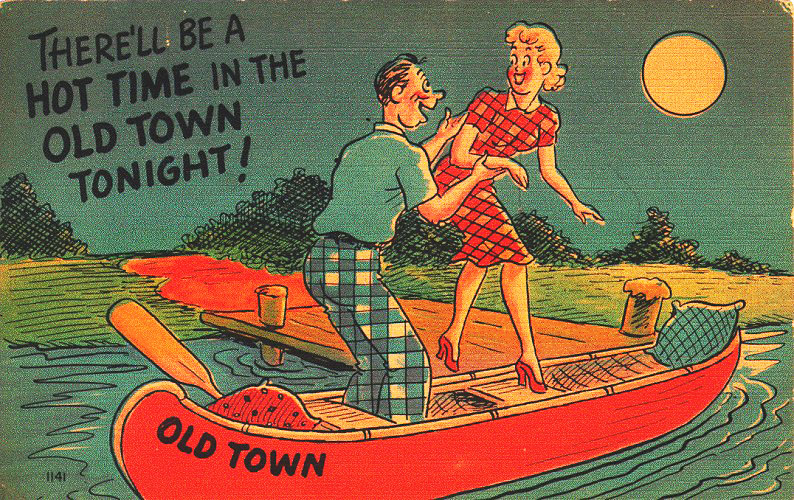
A comic postcard advertising Old Town Canoes makes an open joke of their preferred use. 
Image courtesy Benson Gray.

In 1903, before the trend really took off, a “Boston Herald” article scoffed at the effectiveness of puritanical boating ordinances: “It may not be wicked to go canoeing on the Charles with young women on Sunday, but we continue to be reminded that it is frequently perilous…The canoeist arrested for kissing his sweetheart at Riverside was fined $20. At that rate it is estimated that over a million dollars’ worth of kisses are exchanged at that popular canoeing resort every fine Saturday night and Sunday.”

A 1904 souvenir brochure for the Charles River area emphasized its natural beauty and praised the healthful benefits of boat trips, interspersing scenic photographs with lines of poetry. The pamphlet began, “If you are fortunate enough to be canoeing at sunset…and to spend an evening on the river during a concert or an illumination, to see the canoes appearing one by one, tastily decorated with Japanese lanterns, to hear the sweet tones of a passing guitar or the strains of some glee club floating down stream, you can very easily imagine yourself in Fairyland.” If the make-out potential of a canoe date wasn’t clear enough, accompanying advertisements for no less than 10 different chocolate companies drove the point home.

By 1912, in Minnesota, the undisputed lake capitol of the U.S., canoe permits and rental spaces were off the charts. The Minneapolis Parks Department’s 2,000 permit spaces were almost maxed out, and the city was having a tough time enforcing its 12 a.m. lake curfew. A “Minneapolis Tribune” story reported that, “misconduct in canoes has become so grave and flagrant that it threatens to throw a shadow upon the lakes as recreation resorts and to bring shame upon the city.” Regardless of the curfew, a lot could happen in the dark hours between dusk and midnight, inspiring park police to patrol the lakes for inappropriate behavior on motorized boats equipped with spotlights.


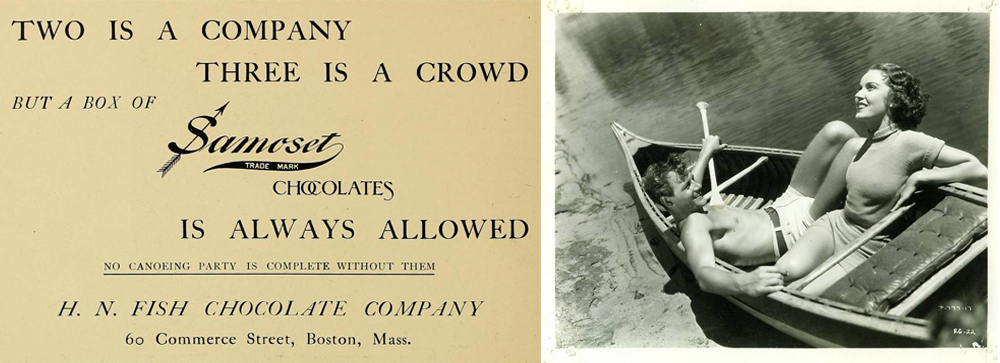
Left: A canoe-centric advertisement for Samoset Chocolates worded to entice romantic twosomes. 

Right: Hollywood finally recognizes the potential of sinful canoeing, over a decade too late, in a publicity still from the 1930s featuring Joel McCrea and Maureen O'Sullivan.

As further proof that canoeing had become a hotbed for teenage delinquents, in 1913 the Minneapolis Parks Board refused to issue permits for canoes with unpalatable names. Local newspapers published some of the offensive phrases that slipped past the board the previous summer, including “Thehelusa,” “Kumomin Kid,” “Kismekwik,” “Damfino,” “Ilgetu,” “Aw-kom-in,” “G-I-Lov-U,” “Skwizmtyt,” “Ildaryoo,” “Win-kat-us,” “O-U-Q-T,” “What the?,” “Joy-tub,” “Cupid’s Nest,” and “I Would Like to Try It.” The commissioners unanimously agreed to outlaw phrases lacking obvious moral and grammatical standards, though a few of these clever pre-text-message abbreviations clearly had them scratching their heads.

Meanwhile, the drama was heightened by a frenzied headline printed by the “Tribune” in June of 1914: “Girl Canoeists’ Tight Skirts Menace Society,” it wailed. In the article itself, F.C. Berry, a supposed park expert on recreational features, warned of the dangers narrow skirts posed to female boaters—in the event of a capsize, they’d be unable to swim.


A postcard from 1906 advertises the supposedly chaste pleasures of night-time boating on the Charles River near Boston.  
Image courtesy Newton Conservators.

Whether or not any actual drownings were attributed to tight skirts, safety wasn’t the top concern for most canoers; a boat’s ability to hold two passengers, preferably side by side, was generally of higher priority. Though the Minneapolis Parks Board attempted to institute an ordinance requiring opposite sex couples (over age 10) to sit facing each other, public outcry helped to quickly repeal the restriction.

By 1916, the canoe-courting trend was widespread enough to warrant mention in a musical comedy called “Tres Rouge” by Jay Gorney, which included a song called “Out in My Old Town Canoe.” But this floating, petting paradise would not last. “When motorcars became more available in the early ’20s, courting in canoes sort of fell off,” says Young. “Guys were getting into their Model Ts or Model As and going off with girls for a Sunday drive instead of canoeing.” And what went on in the backseats of those cars? Well, that’s a whole different story.

(Thanks to Benson Gray, Roger YoungDave SmithShorpyNewton Conservators)


Tuesday, July 31, 2012

WoodenBoat Show 2012

As usual, I headed down to the WoodenBoat Show at Mystic Seaport about this time last month.   Unlike other years, it was hot - like Africa hot.  And muggy.  And still. 

BUT!

That never diminishes the fun to be had at the show - sweaty or not!

I started out my Friday morning by running into a group of good friends just as I came in the gate.  The show always seems to be a place to run into friends both old and new and that's one of the things that's really great about it.  I then headed down to the DuPont Shipyard where a live display of steaming and hanging a plank on the Charles W. Morgan was happening.  They took volunteers from the crowd to help and I managed to sneak by to get some good pictures.  I posted about this previously here.

As I was starting to walk around and see what was on display, I ran into Nick Schade of Guillemot Kayaks strarting to strip a new canoe design of his in his booth.  It was one of the few booths where he had a good combination of shade and a cooling breeze coming off the water.  I asked if he might want a bit of help later - the response?  "Sure."  I'm not sure if he thought I was kidding or not...

I managed to take in most of the boats at the docks that I was interested in as well as most of the vendors before I had to head back to do my first stint in the WoodenBoat School booth.  C'mon - ya gotta have some "booth babes", right?  ;-) 

After that stint, I headed out to get a bite of lunch where I ran into one of my friends again.  I know he hasn't built a boat, but would like to.  I figured heading over to help Nick might give him the push he needed.  So, we went over and spent most of the rest of the afternoon helping Nick strip his canoe and enjoying the cool breezes from the harbor.

That evening when the show closed up, I headed over to visit friends at the annual EBS.  EBS?  Yup.  Elbow Bending Symposium - a gathering with great company, great food and a good time.  Thankfully, the host and hostess let us camp on the grounds for the evening which is very convenient.

The next morning after a hasty breakfast, I headed back over to the Seaport for another stint in the booth.  I arrived to find that the main parking was full and that the secondary parking was as well - they were putting people on the grass at the sides of the road!

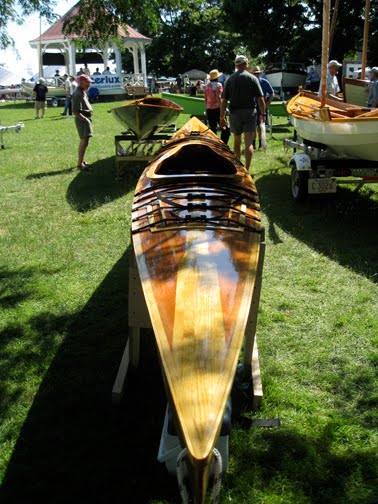
After my stint in the booth, I went out and took a good look at two particular things.  The first was the Interlux sponsored, "I built it myself" display of boats.  Most are built by amateurs and it is fun to see the creativity and talent that is on display.  What is always particularly interesting to me are the unique solutions that they come up with for challenges that they find in the building process.  Some of the solutions are really neat.

The other excellent event is the Family BoatBuilding that goes on under at tent at the show.  Families that have signed up for this event build a boat from start to finish in 3 days.  When the three days are up, all they need to do is to paint, varnish and launch!  Always an impressive display.

I'll leave you with a few of the sights from the show.

Enjoy!


Sunday, July 10, 2011

A trip on the Concord River.

On Friday, I took a little trip down to visit a few fellow WoodenBoat Forum members.  MoMan and Fitz.  While the WoodenBoat forum is not as focused on canoes as, say, the WCHA's Forum, there are still a few of us canoe/kayak people there.

MoMan and his bride are in the Boston area for a bit to celebrate their wedding anniversary. Fitz had the wonderful idea to schedule a paddle for Friday while they were visiting. Seeing as how this was a good opportunity to meet everybody, I thought I'd join them.

The day didn't get off to an auspicious start. It was grey and overcast and strong thundershowers had passed through early in the morning here at the Chateau D'Zaster. As I headed for Fitz's place, it began with isolated pockets of rain which progressed to deluge quantities. For a bit of the drive I had visions of giving Fitz a call and saying, "Maybe some other time..." but I pressed on nonetheless.

Greeted warmly at the Fitz residence I was introduced to Fitz Jr. and the resident mousers. When MoMan arrived with his bride, we were treated to a tour of Fitz's inner sanctum. I think I counted about 15 wooden canoes and a Mill Creek ("Two aren't mine.") He still has at least one more classic canoe on his wish list, 'tho.  Still, an impressive selection:


(Sorry Fitz, I know you're cringing at the picture, but hey, it's a WORKING shop.")

As it had stopped raining, we made the decision to press on and try to go for a paddle anyway - the weather report showed a window of a few hours that would let us partake in the beauty of the area. Like a master sommolier selecting fine vintages from his cellar, Fitz made a selection of a 17 ft. Chestnut Canoe Company, Prospector and 15 ft. Chestnut Canoe Company Bob's Special to take for the day:


Part of the reason that Fitz selected the Ranger for MoMan and his DW to paddle was that this was the boat which was closest to the cedar-strip canoe - A Chestnut Prospector 16 that MoMan is building at home.  His excellent thread on the building process can be found here.

We headed on over to a boat ramp on the Concord river and put in just upstream from Minuteman National Park. Minuteman National Park is the spot where the "Shot Heard Round the World" was fired sparking the American Revolution.

~Take me to the river!~


We paddled downstream through the park passing this guy:


... and then paddling under the Old North Bridge while our group seemed to be the subject of a bit of videography and photography from the bridge. You'd think people hadn't seen wooden boats before.

We paddled downstream through some beautiful countryside enjoying great company and talking about, well, wooden boats. We also passed through a section of the Great Meadows National Wildlife Refuge where we saw many ducks and geese with hatchlings in tow and quite a few blue herons. A deer was browsing off in one of the fields before moving on as we approached. I didn't manage to get any shots of the wildlife as my camera was snugly ensconced in its drybag. I wasn't quite fast enough...

We turned around when we reached a stretch of the river where it widened out into a broad sweep. While it wasn't really sunny, it was warm and humid and the surface of the river was alive with waterbugs rowing their way along. For such a pleasant stretch of the river, I was surprised to see only one other paddler, but given the weather of the day, I guess I shouldn't be.

On the return trip, Fitz started to have some trouble with his bow motor (Note the paddle across the gunwales):


But MoMan and DW seemed to be gliding along nicely:


I managed to be patient enough to get a shot "en masse":


Arriving back at the put-in where we started, there was a group having some sort of tour. I think that the tour guide seemed to lose the attention of about a quarter of the group that sort of shifted over to look at the boats...

We then headed over to the Concord Inn's Tavern for a spot of lunch and some "restorative beverages" (Thanks again, MoMan!) and discovered the problem with Fitz's bow motor - watching the way only a boy of a certain age can nearly inhale food. A bit of beautiful sunshine graced our trip in and out of the Inn.

We headed back to Fitz's to unload boats and to have a quick tour of the Dungeon where the Nick Schade designed Nymph that Fitz built was assembled - quite a challenge considering the space! I had to say my goodbye in order to try to beat some of the traffic and headed south down route 126 along Walden Pond on my way to REI in Framingham for a few goodies and a bottle of pale ale from John Harvard's. Timing appeared to be nearly perfect as it began to rain again as I arrived in Framingham and poured buckets for the rest of my ride home.

Monday, April 4, 2011

Henry 'Mac' McCarthy : Over the Bar


This is not the post I was planning to write tonight. Unfortunately the boat world has lost another pillar. In fact, this is a post I was hoping not to write for quite some time. Mac McCarthy has passed away at the age 0f 83. (That's Mac on the left in one of his creations.) As you can tell if you are a regular reader of my blog, I teach people to build Mac's designs - the Wee Lassie and Wee Lassie II found in his wonderful book, "Featherweight Boatbuilding". We've not tried his Big Mac yet, but I can see it being added to our repertoire one of these days.

All of these canoes are under 14 feet long - he was truly a big man in little boats. Little did I realize that his work and some of his perspective would become such a big influence on the way I think and work.

While my father and I had done some cedar and canvas repair and built a Ted Moores Redbird together, my first solo scratch build was one of Mac's Wee Lassies. Little did I know at the time where this would take me. I was asked to teach a class on the subject at a local school where I teach adults to build these little canoes. One of the first things I did was to drop him an email and ask if he'd be kind enough to offer me some suggestions on how to structure the class. To my great surprise, a very clear and thorough reply was waiting for me that day. He definitely didn't mess about.

When one of my students wanted to "stretch" a Wee Lassie, he had the advice I needed to make it work. When I was finally fortunate enough to get an invitation to teach the class that Mac taught at WoodenBoat, he had some good advice to help get me going in a teaching environment that was very different to the one I was used to. They were very big shoes to try to fill, and I hope that in his eyes, I did his work some justice there.

When at the school, I got some insights into Mac's personality from school director Rich Hillsinger that I didn't fully understand from the limited exchanges of email and phone calls I'd had with Mac. I knew that Mac had been in construction before starting to build canoes. What I didn't know was that he'd brought his work ethic from the construction business to canoe building - and the teaching of canoe building. Apparently in Mac's class, students not only built and trimmed out the canoes with hand-caned seats, many of them also built the paddle as well - in a two week class! That's a pretty aggressive schedule!

Mac also was involved with the WCHA and not only loved to build canoes and teach canoe building, but he truly loved to paddle them as well - particularly on quiet backwaters.

Sadly, Mac suffered from declining health in the past few years and had to give up his shop and go into a managed care facility. Even though he was unable to continue building the canoes he loved, he was able to give interviews and build model boats to occupy his busy mind.

I certainly think it would be fitting to hope that Mac is out there paddling on one of the crystal clear streams that he enjoyed near his Florida home.

Fair winds.

Monday, July 5, 2010

Mystic WoodenBoat Show 2010 : Episode 4


One of the great things that goes on at the WoodenBoat show is the Interlux "I Built It Myself" exhibit. This is a display of owner-built boats from the very small to the fairly large and from the pedestrian to the completely unusual. As this year's honoree was Iain Oughtred, many of the boats that were present had been built to his designs.

These are boats built by people like you and I who have decided that it is time to get started building a boat. These boats are built in sheds, garages, basements and yards. Very often most builders find that once they get started, all of the worries and fears go away and they get what advice, materials and tools they need and just build. I think some even find that they like the building process as much or more than using the boats.

A very nicely made Beach Pea - designed by Doug Hylan. Very tempting...


An Iain Oughtred designed, Jll Yawl named Nina S. Benjamin built by Andrew Kitchen. Most, if not all of the hardware on this boat was hand made. Truly amazing - I'm sorry I didn't get more detail shots of the hardware and the rigging.


Here is something interesting - two Herreshoff-Gardner pulling boats. The top one is Plus One and the bottom one is, obviously, Ruby. What's interesting here is the different take that the two builders had on the finish work and the hull itself. Plus One's builder made her a little bit wider for his use as a fishing platform while Ruby's builders seem to have plans to go fast in her.


This stunning little Delaware Ducker certainly caught the eye. It's very much like a slightly wide sailing canoe in some regards. A very pretty and very traditional build.


Tiller and rudder:
Bow detail:


Ness Yawl, Goldberry by Garth Jones - another Oughtred design - seeing the pattern here?


Willow, built by Howard Sharp to Iain Oughtred's Ptarmigan design:


Annie - a very beautiful double-ender. I'm not certain of the design, but she was certainly a well built boat.


Finally, a still-to-be-named Humblebee pram built by Steven Bauer for use as a tender to his folkboat. Hand made oars as well. She had her maiden voyage at the Seaport on Saturday. What a great memory to have.


Humblebee's Interior.

Wednesday, June 30, 2010

Mystic WoodenBoat Show 2010 : Episode 3


Now personally, I'm a small boat kinda guy. The big stuff holds some interest, but I am always interested to see what others have done with their canoes and kayaks. As a result, I've decided to devote today's post to canoes and kayaks at the show. The picture above shows some restored and un-restored beauties on Robert Ross's trailer. Robert Ross is the owner of Ross Brothers and they specialize in the sale vintage canoes and sporting goods among other things. Here's a nice detail view of an un-restored boat:


I think that the un-restored boats can be as beautiful as the restored boats. Often, the un-restored boats (like those in the Rossi Mill building at Mystic Seaport...) show artwork and detail painted on them that you don't often see put back on restored boats. Things like gilt work and hand painted scroll work. The old boats had some pretty fancy stuff.

Here's another view of Robert's booth showing a lovely courting canoe with long decks and wide thwarts. I love the way that varnish glows in the sun!


Detail of the deck:


He also had this cute 10' long pack canoe and a variety of paddles and oars. DD would probably enjoy something like this as it's a bit wider than my Wee Lassie.


Nick Schade of Guillemot Kayaks had a booth again this year and was featuring his nearly complete Mini-Bootlegger. This kayak was made from 1/8" thick Mahogany strip that was organized as it was cut from the board. The trim was Tiger Maple. A gorgeous effort - and it is available for sale. A mere $23,000.00.


Just look at the grain. Gorgeous.


Chesapeake Light Craft was back as well with their lovely boats on display. I can't say I'm much of a guy for plywood kayaks, but they do a nice job. This is only a small selection from their display - they offer an impressive number of designs for the home-builder.


In the, "I Built it Myself" area at the show this lapstrake sailing canoe based on a Rushton design was just arriving as I was leaving and had no signs on it.


This gentleman built a Redbird to the design of Ted Moores from Bear Mountain Boats and customized it very nicely. One of the customizations was lowering the sheer a bit at the bow and stern. My father and I built a canoe to this design and it is a pleasure to paddle, but the high bow and stern can be pushed around when the wind is up.


A very nice sculpted cherry yoke:


Bird's Eye Maple decks and grab handles:


A slick sliding seat arrangement for the bow paddler. This is a nice feature as such a design will let you shift the seat to adjust the fore and aft trim for paddlers of different weight.


A nice sea kayak - I missed the builder and design information - Oops!


A Tom Hill designed Charlotte lapstrake double-paddle canoe. This is a very popular design and there are quite a few of these about. They are nice, lightweight canoes that let you go where you cannot go with larger boats. I've got the marine plywood and the patterns cut out, but I've got too many other projects going to really get moving on this before I wrap up others!


Finally, a beautiful Wee Lassie built to the design of Mac McCarthy of Feather Canoes. Sadly, Mac's health has not been good, but I'm sure he would be heartened to know that his design won Best of Show for Human Powered craft. This build was faithful to Mac's design and well executed. Michelle Corbeil of WoodenBoat and I were nearly tripping on each other trying to get good photos of this boat. I'm sure her's are much better than mine!


The happy builder with his winner's award.


Still more to come!